When sound helps light save energy
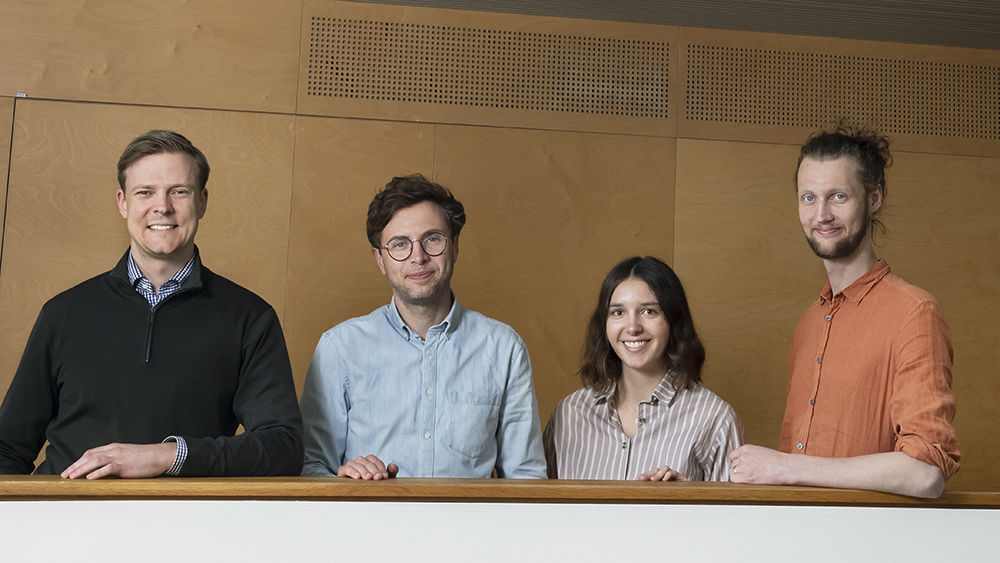
Can sound steer light and cut the energy cost of data traffic? At Chalmers, Raphaël Van Laer’s SSF-backed project explores how acoustics, optics and microwaves can work together on chip-scale hardware for leaner communication.
Light is already the workhorse of the internet. It moves data efficiently over long distances. However, the much shorter links inside servers, chips and data centers still waste large amounts of energy.
The SSF-funded project Attojoule-per-bit acoustic optics, led by Raphaël Van Laer, Associate Professor at Chalmers, aims to change that – by bridging microwave signals to light via sound.
“We see light and hear sound every day of our lives, yet it almost never occurs to us that the two can interact. They feel like they belong to entirely different worlds, with completely different properties,” Raphaël Van Laer comments.
He got into photonics, the study of light, in Belgium, and then did a postdoctoral project in the US. There, he learned about the quantum side of the field, before he started his own lab at Chalmers in Sweden five years ago.
The gift of sound and vision
Light and sound do seem to belong to different worlds. Yet in nanostructures they can interact strongly. Instead of using microwaves to control light directly, Van Laer’s team studies whether microwaves can first generate high-frequency gigahertz sound, which then modulates or converts optical signals with higher interaction strengths and lower power consumption.
The idea is indeed promising. If researchers would reduce the gap between microwaves and near-infrared light, they would in the end be able to reduce the energy used by communication links.
“Sound is a little bit like a mirror for the light. Therefore, when light and sound meet, they can interact with each other. The light bounces off the sound and gets a little frequency shift, like with the Doppler effect in sound,” explains Raphaël Van Laer.
Unfathomably small scale
Put into application, acoustic-optical hardware interacting in the way explained by Raphaël Van Laer, could point toward a future where information can be moved with lower energy per bit.
The real advantage lies not only in the energy required for each individual data transfer, but in the sheer number of such events. As the project name suggests, each transfer in principle involves an extremely small amount of energy: an attojoule is 10⁻¹⁸ joules, an almost absurdly small quantity.
The timing matters. Raphaël Van Laer argues that internet and AI energy use keeps rising rapidly. In that context, lower-loss communication is extremely vital.
“Data centers are in high demand, especially with the AI boom with large language models like ChatGPT. And this energy cost is really going to have an effect on our planet and limit the impact of AI if we don’t do something about it,” Raphaël Van Laer emphasizes.
AI focus for implementation
That is where acoustics meets the AI debate. In large AI systems, storing, moving and shuttling data between components can become as critical as pure computation. If data transport can be made more efficient, the pressure on power budgets, cooling and system design could ease.
In the lab, however, the work is still more fundamental. The team builds on-chip devices and tests how sound, microwaves and light can be linked as efficiently as possible, including at low temperatures relevant for quantum technology.
“Our main focus is not so much on data processing, but rather on data transport and transduction between microwaves and optical light,” explains Johan Kolvik, PhD student in Van Laer’s lab.
To realize the vision, the devices are studied in the Quantum Photonics Lab at Chalmers which Raphaël, Johan and the rest of their team built from scratch after the lab’s inception in 2021.
“The devices we build here in the lab are nano-fabricated to study how sound, light and microwaves interact,” Kolvik explains, referring to the extremely small scales involved.
That makes the project both futuristic and concrete: a search for new physics-based hardware at a time when digital growth is colliding with energy limits.
Chalmers – Acoustic optics
The project Attojoule-per-bit acoustic optics runs between August 2022 and December 2027. It has been awarded a grant of SEK 14,800,000 from the Swedish Foundation for Strategic Research, SSF. Host organization is Chalmers University of Technology, Department of Microtechnology and Nanoscience (MC2).
The Attojoule-per-bit acoustic optics project aims to convert electrical microwave signals to gigahertz sound and then to light. It aims to do so using strong light-sound interactions in tiny nanostructures to cut communication-energy. Potential application areas include cloud systems, supercomputers, AI and quantum technologies.